
Charging Your EV with Solar: How Australians Are Driving for Free
Learn how Australian EV owners are using solar panels to charge their cars for free. Solar sizing guide for EV charging, overnight vs daytime charging strategies for 2026.
6/30/20264 min read
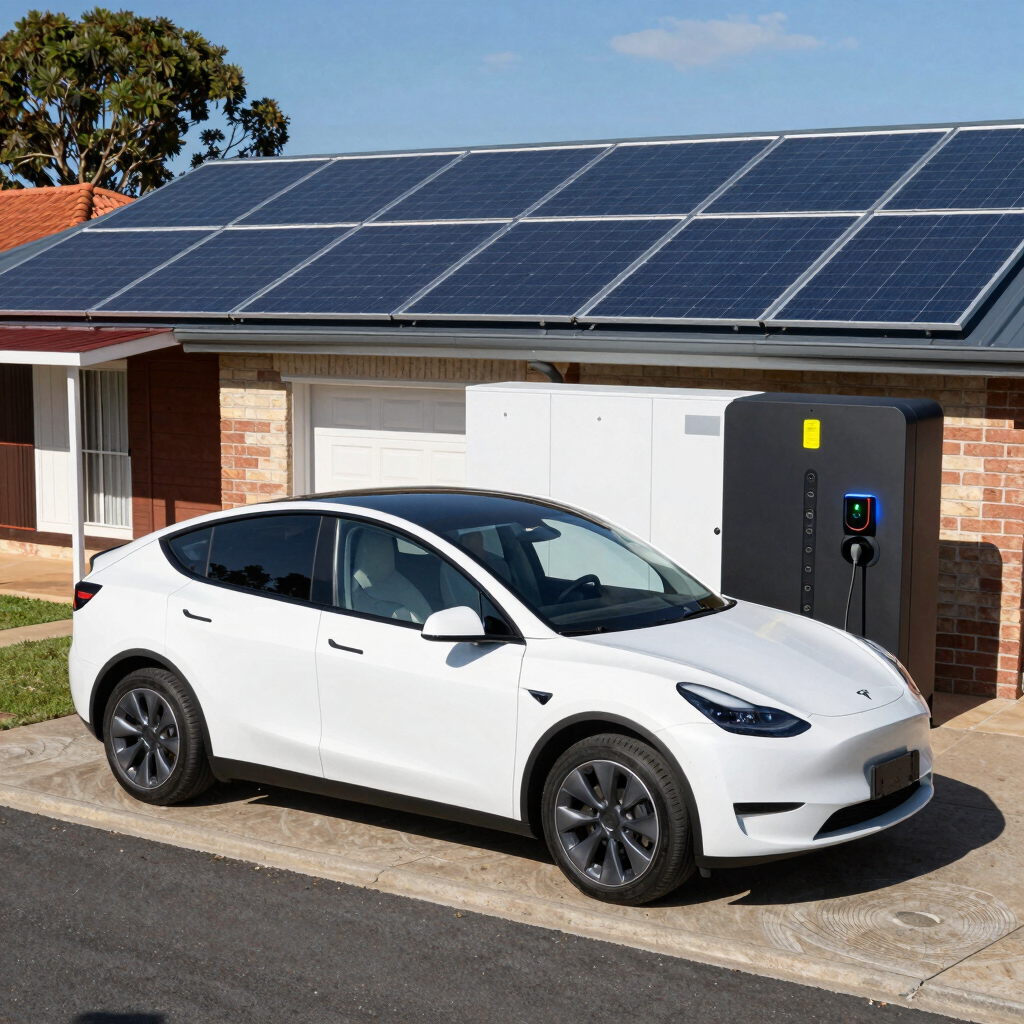
Australia now has one of the fastest-growing electric vehicle markets in the world, and the combination of solar panels and a home battery creates one of the most compelling financial cases for EV ownership anywhere. When your panels generate free electricity during the day and your battery stores it for overnight charging, the cost of fuelling your car approaches zero. In 2026, thousands of Australian households are already doing exactly this.
How much does it cost to charge an EV with solar in Australia?
The cost of charging an electric vehicle depends entirely on where the electricity comes from. Grid electricity in Australia costs between 25 and 38 cents per kilowatt-hour depending on your state, tariff type, and time of day. Charging a 70kWh EV battery from the grid costs between $17.50 and $26.60 per full charge. Over a year of average driving, this amounts to $1,200 to $2,000 in grid electricity costs.
Solar-charged EVs, by contrast, use electricity at near-zero marginal cost. If you have solar panels generating more electricity than your home uses during the day and you can charge your vehicle during those hours, the fuel cost approaches zero. The only cost is the amortised cost of your solar system, which for most households is already paid back through household bill savings.
With a home battery, you can store solar generation during the day and charge your EV overnight from that stored energy, extending the zero-cost charging model to any time of day.
What size solar system do I need to charge my EV?
The solar system size needed to cover EV charging depends on how much you drive and when you charge. As a starting guide, a typical Australian EV uses approximately 18 to 22 kWh per 100 kilometres of driving. A household driving 15,000 kilometres per year uses roughly 2,700 to 3,300 kWh annually for their EV, or 7 to 9 kWh per day.
To generate sufficient solar energy to cover both household consumption and EV charging, most solar installers recommend adding approximately 3 to 5 kilowatts of panel capacity beyond what would otherwise be sized for the household alone. A family home that would have suited a 6.6kW system before adding an EV may benefit from a 10kW system after the EV is factored in.
Daytime vs overnight EV charging with solar
The most efficient solar EV charging strategy is daytime direct charging, connecting your EV to a smart charger that draws power directly from your solar generation during daylight hours. This avoids the conversion losses inherent in storing and then retrieving energy from a battery.
However, daytime charging is only practical if your vehicle is at home and plugged in during solar generation hours, which suits work-from-home households, retired residents, and single-vehicle families where at least one person is home during the day.
Overnight charging from battery storage is the alternative for households where the EV is away during the day. A 10kWh home battery fully charged by solar during the day can provide enough stored energy to cover most overnight EV charges, particularly for average daily driving distances.
The best configuration combines an appropriately sized solar system, a battery large enough to cover both evening household use and overnight EV charging, and a smart EV charger that can prioritise solar generation automatically.
Using a smart EV charger to maximise solar charging
Smart EV chargers allow you to set charging schedules and, in some cases, connect directly to your inverter or battery management system to charge only when surplus solar is available. In 2026, several smart charger brands are available in Australia that offer this solar-aware charging mode, including products from Zappi, Fronius Wattpilot, and several bundled offerings from inverter manufacturers.
This approach is particularly valuable for households on time-of-use tariffs, where grid electricity during peak hours (typically 2pm to 8pm) is significantly more expensive than during off-peak periods.
How Blooming Rays helps EV owners maximise solar charging
Designing a solar and battery system that works optimally with an EV requires thinking about system sizing, charging strategy, and smart charger compatibility together rather than as separate decisions. Blooming Rays works with EV owners across New South Wales to size systems that genuinely meet both household and vehicle charging needs, without oversizing unnecessarily.
Frequently asked questions
Can I charge my EV entirely from solar in Australia?
For most households, yes, over the course of a year. Daily and seasonal solar generation varies, so there will be some days or periods when grid top-up is needed, particularly in winter. However, a well-sized solar-plus-battery system can cover the majority of annual EV charging from solar generation.
Does adding an EV increase my solar payback period?
Adding an EV increases your energy consumption but also increases the value of additional solar generation, since you are replacing expensive grid electricity with free solar power for driving as well as household use. For many households, the additional solar capacity added for EV charging has a strong payback case on its own.
What is the best time to charge an EV with solar in Australia?
Peak solar generation in Australia occurs between approximately 10am and 3pm in most states. Setting your smart charger to begin charging at 10am and stop at 3pm captures the highest generation window and is the most efficient approach for daytime charging.
Can I use a standard powerpoint to charge my EV from solar?
Yes, but slowly. A standard 10-amp Australian powerpoint delivers around 2.4kW of charging power, which adds roughly 10 to 15 kilometres of range per hour. A dedicated EV wall charger operating at 7 to 22kW is significantly more practical for daily use and is compatible with solar-aware smart charging controls.
Contact Us
Sitemap
RayCheck
Contact Us
© 2026. All rights reserved.




Suite 26/208, Level 2, 29 Main St., Rouse Hill NSW 2155
Suite 1208/530, Collins St., Melbourne, VIC 3000