
How to Choose a Solar & Battery Storage System for Your Australian Home
Everything Australian homeowners need to know about sizing, comparing, and choosing a solar and battery storage system — including rebates, payback periods, and what questions to ask your installer.
Blooming Rays
6/16/202610 min read
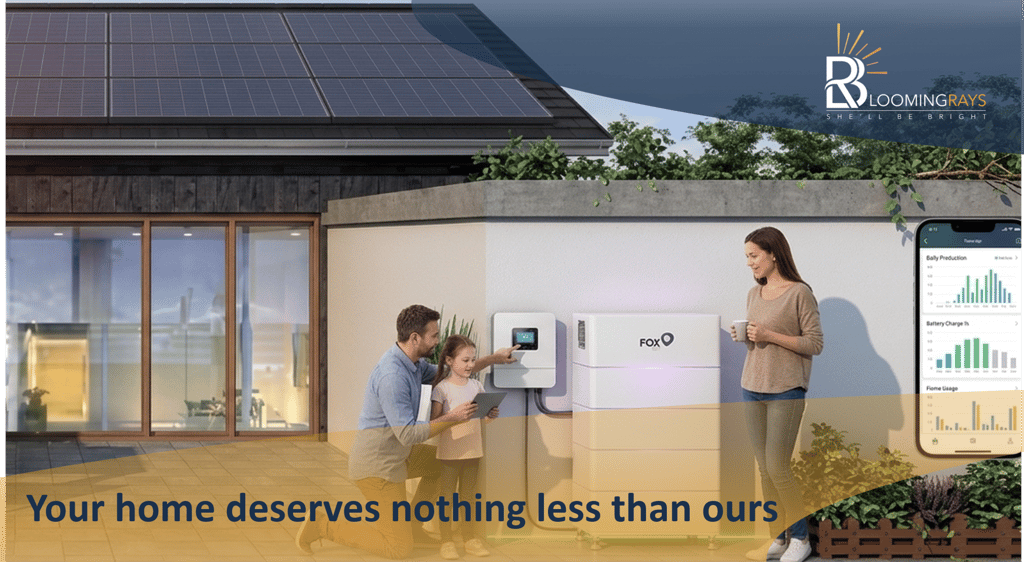
Picture this: you're sitting at your kitchen table with three battery quotes spread out in front of you. Three different brand names, three different kWh figures, three wildly different prices, and a vague feeling that each installer was selling you something specific to what they stock. You wanted clarity. You got a headache.
If that sounds familiar, you're not alone. Australia's solar and battery market has grown faster than most homeowners can keep pace with, and the sheer number of systems on offer in 2026 makes confident decision-making hard to navigate. So, what are the best solar and battery storage systems for Australian homes right now? The good news is they're not as mysterious as the marketing makes them seem. Once you understand what to compare, matching a system to your household becomes a lot more straightforward.
This guide walks you through the top-rated home battery systems available right now, what they realistically cost after rebates, and how to estimate payback for your consumption level. Blooming Rays offers access to multiple vetted system options under one roof, which takes much of the fragmentation out of the process. That context starts with understanding why 2026 has shifted the calculation considerably.
What are the best solar and battery storage systems for Australian homes in 2026?
Australia's grid electricity prices remain high across most states, even with modest downward adjustments in some Default Market Offer (DMO) rates from July 2026. Depending on your state and tariff type, evening grid power can cost anywhere from around 20 cents to over 35 cents per kWh on time-of-use plans, a range confirmed by AER and state default-offer data for 2026. Meanwhile, the energy you generate during the day and export back to the grid earns you somewhere between 4 and 11 cents per kWh from most retailers. That gap is the entire financial case for battery storage, and it's a wide one.
The feed-in tariff problem and why battery storage solves it
Feed-in tariff rates have fallen sharply over the past several years. In NSW, most households now receive between 4 and 10 cents per kWh for solar exports. In Victoria, retailer offers range from near zero to around 11 cents per kWh, with mandatory minimums applying but voluntary rates varying considerably. Queensland rates also vary by retailer and plan. Buying that same energy back after dark costs three to six times as much under most tariff structures. A home battery closes that gap directly: instead of sending cheap solar to the grid and purchasing expensive power at night, you store it and use it yourself. The maths shifts considerably in your favour. For a practical summary of current export payments and how they differ by retailer, see the overview on feed-in tariffs.
How daily consumption patterns affect whether a battery suits you
Not every household benefits equally from battery storage, and being honest about this upfront saves everyone time. The households that gain the most are those with significant evening energy loads: families who are out during the day but home and active from 5pm onwards, homes with electric vehicles charging overnight, and properties with pools or large appliances running in the evening. If most of your energy use happens during solar generation hours, a battery is less critical. Matching battery capacity, measured in kilowatt-hours, to your actual daily evening load is the first calculation worth doing.
What to look for when comparing solar and battery systemsThere's no single "best" battery for every home. The right system depends on your budget, whether you're adding storage to an existing solar setup or starting fresh, and how much capacity you actually need. That said, a handful of systems consistently rise to the top in 2026 based on performance data, warranty terms, and SolarQuotes user ratings and performance data.
What round-trip efficiency and capacity actually mean
Round-trip efficiency, the percentage of stored energy you actually get back out, is one of the most useful numbers for comparing systems, since the best available batteries on the market sit between 95 and 98 per cent. Modular battery designs that scale from around 5 kWh up to 40 kWh or more are worth prioritising if you might expand your system later, since you can add capacity without replacing the whole unit. Look for a 10-year minimum warranty as the baseline, and confirm the system has current Clean Energy Council approval, since this determines your eligibility for the federal financial incentive. Thermal management matters too: Australian conditions range from coastal humidity to inland heat extremes, so a battery with proven performance across that range, and an installation base to back it up, reduces the risk of premature degradation.
The Australian market in 2026 includes a wide range of well-engineered residential battery systems from established manufacturers. The strongest options share common characteristics: storage capacity between 10 and 15 kWh, which suits most family homes; round-trip efficiency at or above 95 per cent; at least a 10-year warranty with specified capacity retention; and compatibility with common Australian inverter platforms. Some systems are highly modular, allowing you to start with a smaller capacity and expand as your needs or budget grows. Others are all-in-one units that simplify installation. Neither approach is inherently better; the right choice depends on your current setup and future plans. What matters most is working with a provider who carries multiple systems and can match the right one to your household rather than defaulting to whatever they stock in bulk.
Why access to multiple brands matters when choosing the best home battery in Australia
Here's a practical reality many homeowners discover too late: some installers stock a limited range of brands, which means their "recommendation" can be shaped more by what they carry than by what suits your home. Getting well-rounded guidance means working with a provider who carries multiple systems across different price and performance tiers. Blooming Rays' RayCheck is structured around exactly this principle, multiple vetted brands, one point of accountability from quote through to installation. That approach removes much of the fragmentation that makes shopping for the best solar and battery systems for Australian homes so frustrating.
Hybrid, AC-coupled, and DC-coupled: which system type suits your home
Choosing a battery also means choosing a system architecture, and this decision catches many buyers off guard. The type of setup you need depends primarily on whether you already have solar panels installed. Broadly, you're looking at two paths: retrofitting storage onto an existing system, or designing a combined solar-and-battery setup from the ground up.
Retrofitting existing solar: why AC-coupled is usually the right call
If you already have a solar system on your roof, an AC-coupled battery retrofit is almost always the most practical path. These systems add battery storage without replacing your existing inverter, which keeps disruption and cost lower. The solar generation side and the battery side remain independent, which also improves resilience: if one component has an issue, the other continues working. There is a slight efficiency trade-off compared to DC-coupled designs because of additional power conversion steps, but for most retrofit situations, the cost savings and simplicity easily outweigh that difference.
New installs: the efficiency case for DC-coupled hybrid inverters
If you're starting from scratch with both solar panels and a battery, a DC-coupled hybrid inverter system is worth considering. By using a single inverter to manage both solar generation and battery storage, DC-coupled systems reduce conversion losses and simplify your overall setup. Fewer components generally means fewer points of failure. The key consideration for new installs is inverter-battery compatibility: not all hybrid inverters pair equally well with all battery brands, which is another reason having a multi-brand provider who understands the full system picture is valuable from day one.
What the best solar and battery storage systems cost in Australia in 2026, and the rebates that help
Cost is where most homeowners need the clearest picture, and vague ranges don't help anyone plan. Here's what a complete installed system typically costs across three common configurations, followed by the rebates that bring those numbers down.
Installed price ranges for common system sizes
Based on current 2026 market pricing, a 5kW solar system with a 5 kWh battery installed typically costs between $12,000 and $18,000. Step up to a 10 kWh battery and you're looking at $14,000 to $22,000 installed. A 13.5 kWh battery alongside 5kW of solar generally falls in the $17,000 to $28,000 range. Price variation within those bands reflects battery brand, chemistry, whether you need a hybrid inverter, and site-specific installation complexity. A standard roof on a single-storey home in a metropolitan area will almost always sit toward the lower end of the range.
Federal financial incentives and state incentives worth knowing about
The federal Cheaper Home Batteries Programme delivers a significant upfront discount through the Small-scale Renewable Energy Scheme. There's no income test, and the financial incentive is applied at the point of installation by your accredited installer. As of May 2026, the programme uses a tiered structure: batteries from 0 to 14 kWh receive a 100 per cent incentive factor, 14 to 28 kWh receives 60 per cent, and 28 to 50 kWh receives 15 per cent. With STCs trading near the $40 mark, roughly $39.30 as tracked in recent spot data, this translates to approximately 30 per cent off upfront cost for a typical residential battery (based on a standard 13.5 kWh system at current STC rates).
State and territory incentives vary considerably. The ACT offers an interest-free loan of up to $10,000, stackable with the federal financial incentive. Victoria has a similar interest-free loan up to $8,800. The Northern Territory offers a rebate of $400 per kWh up to $12,000. Queensland, South Australia, and Tasmania currently rely on the federal financial incentive alone, with no separate state battery programme announced as of mid-2026. NSW homeowners may have access to the Peak Demand Reduction Scheme as a stackable benefit, but confirm current 2026 eligibility directly before signing anything. State programmes can change quickly, and the most reliable starting point is always confirming your entitlement before committing to a purchase.
Payback periods and annual savings: what households like yours are seeing
The payback question is the one that ultimately decides whether a battery makes sense for your situation. The honest answer is that it varies quite a bit, but the ranges are well-documented enough to give you a useful starting point.
Low, medium, and high consumption households compared
Annual savings and payback periods differ significantly depending on how and when you use energy:
Low-consumption households with modest evening loads typically save $500 to $800 per year, putting payback at around 8 to 12 years.
Medium-consumption homes, the classic family scenario with regular evening use and a few large appliances, generally save $800 to $1,200 per year, with a payback period of 6 to 9 years.
High-consumption households with EVs, pools, or large evening loads often see savings of $1,200 to $2,000 or more annually, and payback can drop to as little as 3 to 6 years.
Illustrative example only, actual results vary by household: a concrete Sydney scenario puts this in perspective, with a net battery cost of $6,343 after rebates, annual savings of $821, and a 7.7-year payback period. This is an indicative estimate for a medium-consumption home, not a guaranteed outcome.
How to estimate your own numbers before talking to an installer
Pull out your last three electricity bills and check two things: your total daily consumption in kWh, and what time of day that usage is heaviest. If the bulk of your load falls after 5pm, a 10 to 13.5 kWh battery will cover most of it on a typical day. If your bills show low overall consumption and most of it during daylight hours, a smaller battery, or no battery at all for now, may serve you better. This preparation doesn't just give you a better sense of your own payback numbers; it also leads to far more accurate quotes from installers, because you're walking in with real data rather than a rough guess.
Your next step toward a system that actually fits your home
The best solar and battery storage system for your home isn't the one with the biggest marketing budget. It's the one matched to your consumption patterns, your roof, your budget, and your state's rebate structure. Understood clearly, those four factors make the shortlisting process quite manageable.
The single smartest move before committing to any system is getting two or three quotes from installers who carry multiple brands, advice backed by consumer advocacy guidance and industry bodies alike. That way, the recommendation you receive is driven by your needs rather than by what one supplier happens to have available. Blooming Rays is built around exactly this principle: access to systems including Sigenergy, Sungrow, and other top-rated brands through one accountable provider, with guidance that helps you compare properly rather than pick from a limited shelf.
You've now got a clear picture of the best solar and battery storage systems for Australian homes in 2026, what they cost, which rebates apply in your state, and what a realistic payback looks like for your household type. The next step is straightforward: reach out to Blooming Rays for a personalised quote and walk into that conversation knowing the right questions to ask.
Frequently asked questions
What are the best solar and battery storage systems for Australian homes in 2026?
The Australian market in 2026 includes a strong range of well-regarded residential battery systems. The best choice for your home depends on your household energy consumption, your existing solar setup (if any), your budget, and which state rebates you are eligible for. A qualified installer who carries multiple brands will assess these factors and recommend a system based on your actual situation rather than defaulting to a single product.
How much does a solar and battery system cost in Australia?
Installed costs in 2026 typically range from $12,000, $18,000 for a 5kW solar system with a 5 kWh battery, up to $17,000, $28,000 for a 5kW system with 13.5 kWh of storage. Federal financial incentives, and state rebates can reduce these figures by approximately 30 per cent or more for eligible systems.
What battery rebates and incentives are available in Australia?
The federal Cheaper Home Batteries Programme provides a tiered financial incentive through the Small-scale Renewable Energy Scheme, with no income test. Additional state incentives include ACT and Victoria interest-free loans, and an NT rebate of $400 per kWh. Queensland, South Australia, and Tasmania currently rely on the federal programme alone as of mid-2026.
What is the payback period for a home battery in Australia?
Payback periods typically range from 3 to 12 years depending on household consumption. High-consumption homes with EVs or pools often see payback within 3 to 6 years, while low-consumption households may wait 8 to 12 years.
Should I choose AC-coupled or DC-coupled battery storage?
If you're retrofitting storage onto an existing solar system, AC-coupled is usually the most practical and cost-effective option. For new combined solar-and-battery installs, a DC-coupled hybrid inverter system offers better efficiency and fewer components overall.o carry multiple brands. That way, the recommendation you receive is driven by your needs rather than by what one supplier happens to stock. Blooming Rays is built around exactly this principle: access to a vetted range of well-regarded systems through one accountable provider, with guidance that helps you compare properly rather than pick from a limited shelf.
Contact Us
Sitemap
RayCheck
Contact Us
© 2026. All rights reserved.




Suite 26/208, Level 2, 29 Main St., Rouse Hill NSW 2155
Suite 1208/530, Collins St., Melbourne, VIC 3000