
Solar Feed-in Tariffs Australia 2026: Best Retailer Rates
Compare solar feed-in tariffs Australia 2026 across energy retailers. See which providers pay the best rates for solar exports in NSW, VIC, QLD, SA and WA.
6/18/20265 min read
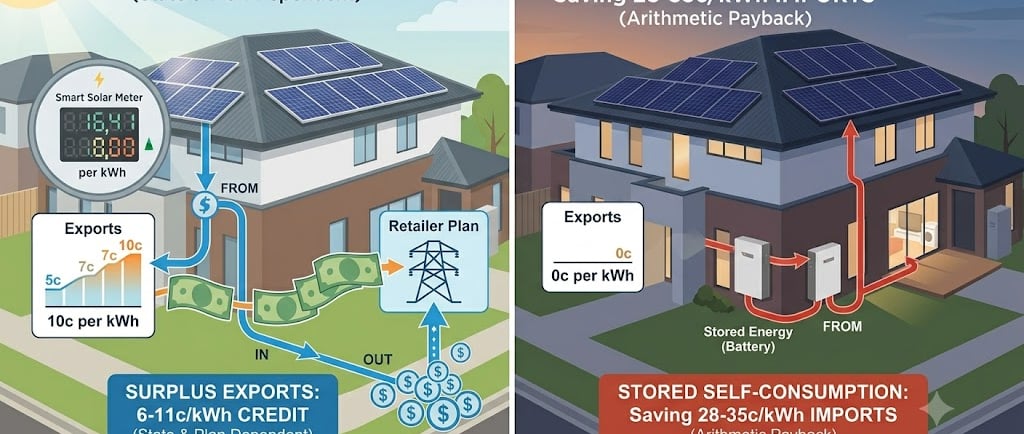
If you have solar panels on your roof, the rate your retailer pays you for excess electricity exported to the grid, your feed-in tariff, has more impact on your annual savings than most people realise. In 2026, Australian feed-in tariff rates range wildly from near-zero to around 11 cents per kilowatt-hour, depending on your state, your retailer, and your plan. Choosing the right retailer for your solar exports can be worth hundreds of dollars a year. This guide breaks down what Australian solar owners are actually earning on their exports right now.
What is a solar feed-in tariff and how does it work in Australia?
A feed-in tariff (FiT) is the rate your electricity retailer pays for every kilowatt-hour of solar energy your panels generate and export to the grid. When your system produces more electricity than your home uses at that moment, the surplus flows back into the grid, and your retailer credits your bill at the agreed feed-in rate. In most states, this rate is negotiated through your energy plan rather than set by government mandate, though minimum guaranteed rates apply in some states.
The mechanics are straightforward: your solar meter tracks exports separately from imports, and your quarterly bill shows both the electricity you've bought from the grid and the credit you've earned from exports. Higher feed-in tariffs mean more bill credit per exported kilowatt-hour, directly reducing what you pay each quarter.
Solar feed-in tariff rates by state in 2026
Feed-in tariff rates vary considerably by state because electricity markets are structured differently across Australia. Here is what households can realistically expect in each major state as of mid-2026.
New South Wales
NSW solar households receive feed-in tariffs from their chosen retailer, with no mandatory minimum rate applying as of 2026. Competitive retailers offer between 5 and 10 cents per kilowatt-hour on standard plans. Time-varying feed-in tariffs are also available from some retailers, offering higher rates for exports during peak demand periods, which can improve returns for households whose systems produce well in the late afternoon.
Victoria
Victoria applies the Victorian Default Offer (VDO) minimum feed-in tariff, which for 2026 sits around 3.3 cents per kilowatt-hour as the regulatory floor. However, competitive retailers routinely offer voluntary rates significantly above this, with some providers offering 6 to 11 cents per kilowatt-hour. Shopping around in Victoria is particularly worthwhile because the gap between the worst and best offers is significant.
Queensland
Queensland operates under a deregulated retail market in most areas, with no mandatory minimum feed-in tariff outside specific legacy arrangements. Standard retailer feed-in offers range from about 5 to 10 cents per kilowatt-hour. Some retailers also offer solar bonus arrangements tied to off-peak plans that can be worth exploring depending on your export profile.
South Australia
South Australia has some of the highest electricity tariffs in the country, and feed-in tariffs from competitive retailers range from around 5 to 10 cents per kilowatt-hour. South Australia is also the state where battery storage and VPP participation can further enhance the value of your solar investment beyond the base feed-in rate.
Western Australia
Western Australia's Synergy-dominated retail market offers the Distributed Energy Buyback Scheme (DEBS) as the primary mechanism for solar exports. In 2026, DEBS rates are tiered by time of day: a higher rate applies during peak export periods and a lower rate during off-peak hours. For WA households, export timing matters more than in other states.
Why the feed-in tariff gap makes battery storage compelling
The core financial argument for home battery storage in 2026 is simple arithmetic. If you export solar at 6 cents per kilowatt-hour and buy grid power back at 28 to 35 cents per kilowatt-hour in the evening, the cost of storing that energy yourself instead of exporting it pays back the difference every single day. A household exporting 10 kWh daily at 6 cents earns 60 cents in credits. That same 10 kWh purchased back at 30 cents costs $3.00. The annual gap is substantial, and it is the primary driver behind Australia's rapid battery uptake in 2026.
How to compare feed-in tariff offers effectively
Comparing solar feed-in tariffs requires looking at the full energy plan, not just the headline export rate. A plan offering 10 cents per kilowatt-hour on exports may charge 38 cents per kilowatt-hour for imports, while a plan offering 7 cents on exports might only charge 24 cents for imports. The net position across both import and export over your actual consumption pattern is the number that matters.
The Australian Energy Regulator's Energy Made Easy comparison tool allows you to enter your annual consumption and export volumes to compare plans on a like-for-like basis. For households generating significant solar, running this comparison annually is worthwhile, as retailer offers change frequently.
Getting the most from your solar exports with Blooming Rays
Blooming Rays works with homeowners across New South Wales and beyond to ensure their solar and battery systems are configured to maximise the value of every kilowatt-hour their panels generate. Whether you are weighing up the export value of going battery-ready, or simply trying to understand which energy plan suits your current system, our team provides guidance based on your actual consumption data rather than generic assumptions.
The combination of an optimised solar system, a well-matched battery, and the right energy plan is where Australian households see the strongest financial returns in 2026. Understanding your feed-in tariff position is the first step in that process.
Frequently asked questions
What is a good solar feed-in tariff rate in Australia in 2026?
A competitive feed-in tariff in 2026 falls between 6 and 11 cents per kilowatt-hour depending on your state. Rates below 5 cents are below market, and rates above 10 cents are generally only available on time-varying plans or through specific retailer promotions.
Do I have to accept the default feed-in tariff from my current retailer?
No. In most states, feed-in tariffs are part of your energy plan and can be compared and switched like any other tariff component. Reviewing your export rate annually against competing offers is straightforward and can yield meaningful savings.
Does adding a battery affect my feed-in tariff?
Adding a battery reduces your solar exports significantly because more of your generation is stored and consumed at home. Your feed-in tariff rate will still apply to any remaining exports, but the volume of exports typically drops when a battery is installed. Most households find this trade-off strongly in their favour given the import price gap.
Can I get a higher feed-in tariff by participating in a virtual power plant?
Yes. Some VPP programmes, particularly in South Australia and Victoria, offer enhanced feed-in rates or bill credits in exchange for allowing your battery to be dispatched to the grid during high-demand periods. These programmes are worth investigating for households with battery storage already installed.
Is the feed-in tariff rate the same all day?
Not necessarily. Time-varying feed-in tariffs pay more for exports during peak grid demand periods, typically late afternoon on hot days, and less during midday when solar generation across the grid is highest. For households with batteries, time-varying tariffs create an incentive to store midday generation and export strategically.
Contact Us
Sitemap
RayCheck
Contact Us
© 2026. All rights reserved.




Suite 26/208, Level 2, 29 Main St., Rouse Hill NSW 2155
Suite 1208/530, Collins St., Melbourne, VIC 3000